Aquila Formula 1000:
Atomkraft Motorsport Event Nordic AB
Kantarellgränd 39
18245 Enebyberg
Promotor: Johan Varland
Tel: +46 70 756 29 78
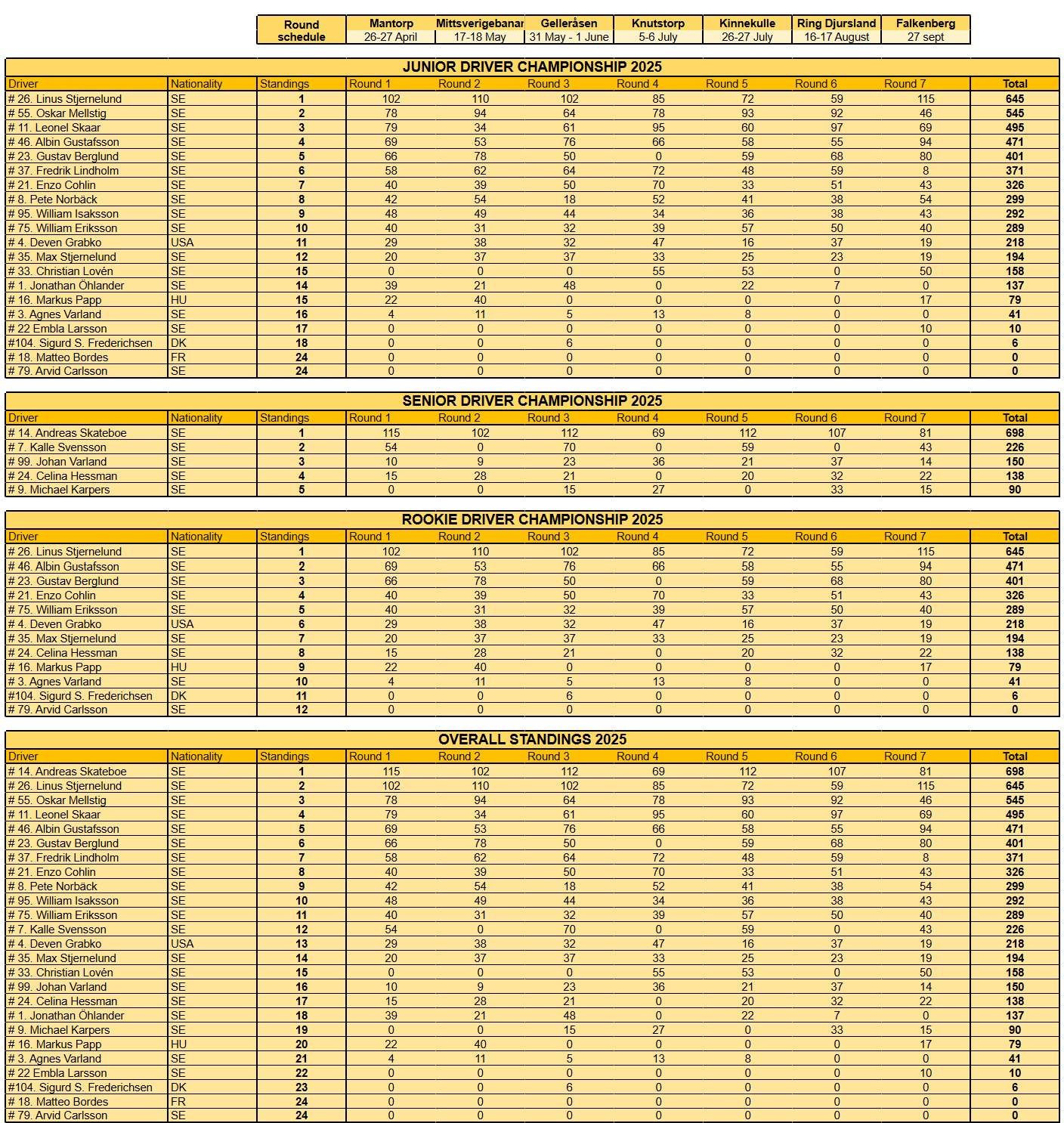
This is how the point allocation looks in Aquila Formula 1000: 25-22-20-18-16-15-14-13-12-11-10-9-8-7-6-5-4-3-2-1.
To get points, you must have completed at least 75% of the winner’s laps. A driver who is disqualified receives no points. In the qualification you also get points according to the above points scale. So if you are, for example, third in Quali you get 22 points.
Bet Builder — sometimes called Same Game Multi or SGM depending on the platform — has become one of the most structurally complex products in retail and online sports betting. What appears to the user as a simple drag-and-drop interface for combining selections within a single match is, underneath, a sophisticated pricing engine that must solve a problem traditional accumulator systems were never designed to handle: correlated outcomes. When you combine a player to score first, his team to win, and the match to have over 2.5 goals, those three events are not statistically independent. Traditional parlay pricing assumes independence and multiplies the decimal odds together. Bet Builder cannot do that without significantly mispricing the product — sometimes in the customer’s favour, sometimes against. The technology that bridges this gap has evolved substantially since the first commercial implementations appeared around 2016 and 2017, primarily driven by operators trying to retain customers who were building their own correlated multiples through matched betting forums.
The foundational challenge in Bet Builder pricing is quantifying the statistical relationship between any two selections drawn from the same event. In probability theory, the joint probability of two correlated events A and B is not simply P(A) × P(B). It equals P(A) × P(B|A) — the probability of A multiplied by the conditional probability of B given that A has already occurred. For a single two-leg Bet Builder, this is manageable. For a five or six-leg combination, the computational complexity grows exponentially because you need to model the conditional relationship between every possible pair and cluster of selections simultaneously.
Early implementations, notably those built in-house by larger operators around 2017 to 2019, used a correlation matrix approach. Each market type was assigned a correlation coefficient relative to every other market type, derived from historical match data. A goal scorer market and a match result market would carry a high positive correlation coefficient; a booking market and a corners market would carry a moderate positive correlation; a first goalscorer and the number of yellow cards would carry a near-zero correlation. The pricing engine would then adjust the combined implied probability upward or downward based on these pre-calculated coefficients. The problem with this approach was that the coefficients were static — they did not account for in-match context, player availability changes, or the specific teams involved.
The generation of Bet Builder engines that emerged after 2020 moved toward dynamic correlation modelling, where the adjustment factors are recalculated in near real-time using event-specific data. A player starting on the bench has a materially different correlation profile to a first goalscorer market than a player confirmed in the starting eleven. Platforms that integrated squad confirmation feeds — typically sourced from Opta, Stats Perform, or proprietary data partners — were able to reprice their Bet Builder markets in the 60 to 90 minute window between lineup confirmation and kick-off, which is precisely the window when most Bet Builder volume is placed.
Once the joint probability has been calculated with correlation adjustments applied, the platform must convert that figure into a displayed price while embedding its margin. In standard single-market pricing, operators apply an overround — typically between 104% and 110% for a two-way market in football — by inflating the implied probabilities of all outcomes so they sum to more than 100%. In Bet Builder, the margin application is less transparent and varies considerably between operators.
One common approach is margin stacking, where each leg of the Bet Builder carries its own individual market margin, and these margins compound through the combination. A four-leg Bet Builder where each leg carries a 6% margin would result in a combined margin significantly higher than 6% — the exact figure depends on the prices involved, but compounding effects can push the effective margin on a four-leg combination into the 20% to 30% range. This is why the displayed Bet Builder price is frequently lower than what a naive multiplication of the individual market odds would produce, even after accounting for correlation adjustments. A portion of that reduction is legitimate correlation correction; another portion is margin stacking that benefits the operator.
Some platforms have experimented with a flat-margin model, where a single margin is applied to the final combined price rather than stacking margins per leg. This produces a more competitive price for multi-leg combinations and has been used as a product differentiator. Comparative analysis of Bet Builder pricing across platforms — such as the data compiled at http://betzella.com/which-app-has-best-bet/, where app-level pricing comparisons are documented — consistently shows that the effective margin on equivalent four-leg football Bet Builders can differ by eight to twelve percentage points between operators using stacking versus flat-margin approaches. That difference has a direct and measurable impact on long-run expected return for the customer.
From an operator risk perspective, Bet Builder creates a liability profile that is fundamentally different from standard singles or traditional accumulators. Because the legs are drawn from the same event, a single match outcome can simultaneously trigger multiple winning legs across a large volume of Bet Builder tickets. This is called correlated liability concentration, and it represents one of the primary reasons operators were initially reluctant to offer the product at all.
Modern Bet Builder risk engines monitor aggregate liability on specific combinations in real time. If a disproportionate volume of tickets includes, for example, a specific player to score and the home team to win by two or more goals, the risk system can flag this combination for price adjustment or, in some implementations, for referral to a trading desk. The threshold at which automatic repricing triggers varies by operator and by event tier. A Champions League group stage match at a major operator might have tighter liability thresholds and more aggressive automated repricing than a Championship fixture at a smaller platform, simply because the volume of Bet Builder activity on the former is substantially higher.
Betzella has documented cases where the same underlying combination — identical legs, identical teams, identical match — carried materially different prices across platforms not because of different correlation models, but because one platform had already accumulated liability on that combination and adjusted its price accordingly. This is an important distinction for sophisticated bettors: a lower Bet Builder price is not always a sign of a worse pricing model. It can indicate that the market has already moved due to one-sided action, which is itself informative.
The integration of Bet Builder with in-play markets has added another layer of complexity. Pre-match Bet Builders are typically locked once the match begins — the legs cannot be edited — but some platforms now offer in-play Bet Builder functionality, where selections can be added after kick-off at live prices. Pricing an in-play Bet Builder requires the correlation model to account not just for historical base rates but for the current match state: score, time elapsed, red cards, and momentum indicators derived from event data feeds. The data latency requirements for this are significantly more demanding than pre-match pricing, and as of 2024, only a handful of platforms have implemented it at scale without material pricing errors.
In regulated markets, Bet Builder products are subject to the same transparency and fairness requirements as any other betting product, but the complexity of the pricing mechanism creates specific audit challenges. In the United Kingdom, the Gambling Commission’s licence conditions require that betting products operate in a manner that is fair and that customers are not misled about the nature of the product. The implicit margin embedded in a Bet Builder combination is not typically disclosed to the customer at the point of sale, which has drawn attention from consumer advocacy groups since at least 2021.
The Irish regulatory framework, updated under the Gambling Regulation Act 2024, introduced requirements for operators to provide clearer information about expected return on complex betting products, which Bet Builder falls under by most interpretations. How this will be implemented in practice — whether through displayed RTP percentages, marginal odds disclosure, or some other mechanism — remains under consultation as of the time of writing. Betzella has tracked these regulatory developments as part of its broader coverage of platform-level product differences, noting that operators with existing transparency infrastructure are better positioned to comply with disclosure requirements without significant product redesign.
Understanding how Bet Builder pricing actually functions — from the correlation adjustment layer through to margin application and real-time liability management — matters because it reframes the product from a simple convenience feature into a distinct market with its own pricing dynamics. The gap between the best and worst Bet Builder pricing in any given market is not trivial; over a meaningful sample of bets, the difference in effective margin compounds into a substantial difference in outcome. Bettors who treat Bet Builder as a uniform product across platforms, rather than as a market where pricing quality varies significantly by operator and by combination type, are leaving a measurable edge unexamined.


